Why reading matters
At Sybil Andrews Academy, reading and literacy are at the heart of our curriculum because we believe that students who read more, know more and be more are empowered to achieve success both in school and beyond. Guided by our values of Kindness, Courage and Responsibility, we foster a culture where students are supported to become confident readers, thoughtful communicators and independent learners. We encourage kindness through respectful discussion and shared reading experiences, courage in tackling challenging texts and new vocabulary, and responsibility in developing positive reading habits.
Our aim is for every student to gain meaning from what they read, develop strong comprehension skills, and communicate their ideas effectively through speaking and writing. By understanding and supporting each stage of the reading, writing and communication journey, we equip students with the knowledge, confidence and skills they need to thrive academically and personally.
Reading
Sybil Andrews Academy encourages reading for pleasure and endeavours to actively promote this as reading is one of the key literacy building blocks in academic success. it is imperative that all subject areas are aware of the importance of reading and contribute to its successful teaching.
We teach students to:
- read fluently
- read a wide range of texts: fiction and non-fiction, different genres, pre-twentieth century and modern
- read with understanding
- locate and use information
- provide evidence for arguments/research
- follow a process or argument
- summarise, synthesise and adapt what they learn from their reading

Sybil Reads Tutor Time Programme
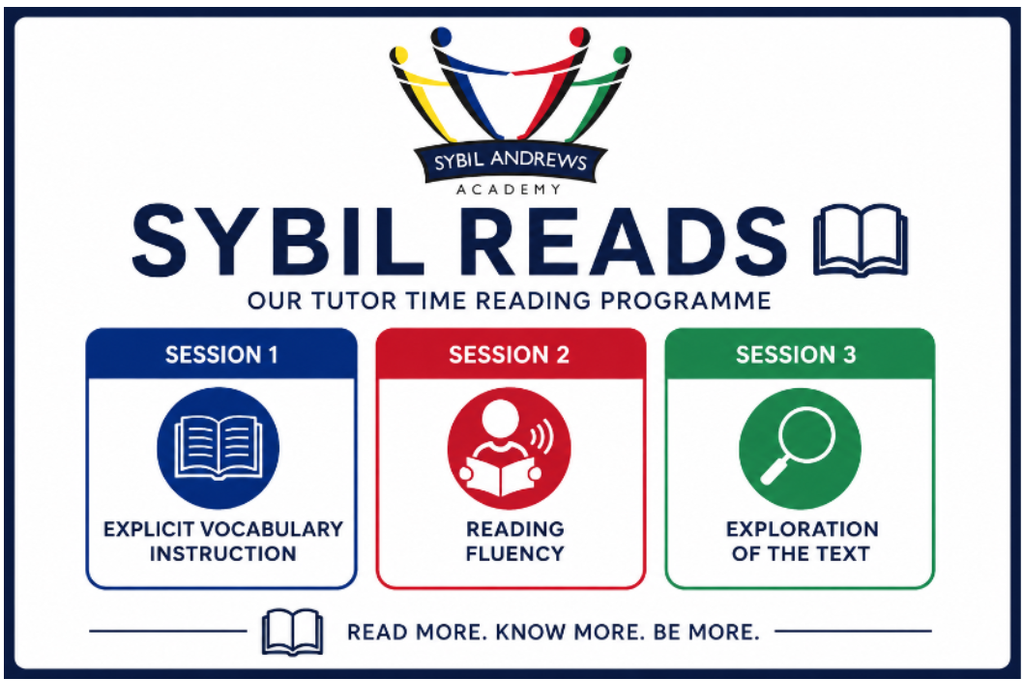
Sybil READS is our tutor-time reading programme, delivered through three sessions each week. Each session has a distinct focus to support students in becoming confident, fluent and engaged readers.
- Explicit vocabulary instruction helps students develop their understanding of ambitious and subject-specific language.
- Reading fluency sessions support students in reading accurately, automatically and with expression (prosody).
- Text exploration sessions encourage students to think deeply about what they have read, develop comprehension skills and engage in meaningful discussion.
Through these structured sessions, Sybil READS helps students broaden their vocabulary, improve reading fluency, strengthen comprehension, and develop the confidence needed to access the wider curriculum and achieve academic success.
Reading across the Curriculum
At Sybil Andrews Academy, reading is the responsibility of every subject. We recognise that strong reading skills are essential for success across the curriculum and in later life. All departments support reading by explicitly teaching subject-specific vocabulary, modelling and developing fluent reading, and providing regular opportunities for students to engage with high-quality texts. These texts are carefully selected to broaden students’ knowledge, deepen their understanding of the subject, and expose them to ambitious language. Through consistent approaches to vocabulary instruction, reading aloud, and comprehension, we help students access increasingly challenging material and become confident, independent readers.
Reading Pathways
Students who may benefit from additional reading support are identified through a range of assessments, including prior attainment data, reading age assessments, classroom observations, progress reviews, SEND information, and referrals from staff, tutors and families. We work closely in partnership with families to ensure that any concerns or information shared are taken into account. Once identified, students are matched to the most appropriate support, which may include our whole-school reading strategy, small-group interventions, targeted one-to-one support, Lexia programmes, and inclusion-based reading interventions, ensuring every student receives the level of support they need to become confident and successful readers.
Reading
Whole school reading
- High-quality teaching of reading fluency through prosodic reading strategies.
- A structured tutor-time reading programme.
- Explicit vocabulary instruction (EVI).
- Reading fluency interventions during tutor time, including repeated reading, echo reading and choral reading.
- Book recommendations displayed in classrooms and tutor rooms.
- Reading displays and reading challenges, with certificates and praise points to encourage engagement.
Group Reading Support
- Paired reading programmes.
- Reading Club.
- Potential withdrawal from French for lower prior-attaining students to allow additional focus on reading development.
- Use of reciprocal reading strategies to strengthen comprehension and discussion skills.
- Lunchtime reading spaces with adult support available in the library.
Targeted Interventions
- One-to-one reading sessions with a Learning Support Assistant (LSA) as part of an Inclusion Support Plan.
- Use of Lexia to provide personalised reading support and intervention.
- Home reading support packs for parents and carers to help reinforce reading skills outside of school.
Reading in English
The English curriculum places reading at its heart, combining challenging texts from both the literary canon and contemporary literature to develop students’ knowledge, understanding and enjoyment of reading.
Key features of reading provision in English include:
- Reading for Enjoyment units at the start of each academic year, exposing students to a range of texts and encouraging independent reading habits.
- Guided Reading lessons at Key Stage 3, where students develop reciprocal reading skills through engagement with a variety of fiction and non-fiction texts that broaden their cultural awareness and perspectives.
- Explicit vocabulary instruction, including strategies such as Frayer models and vocabulary deep-dives, helping students understand and confidently use ambitious vocabulary.
- Oracy and reading aloud in every lesson, with teachers modelling expert prosody and providing opportunities for students to practise fluent, expressive reading.
- Reading and vocabulary-focused homework, designed to reinforce learning, expand vocabulary and promote reading beyond the classroom.
Through these approaches, English lessons foster a culture of reading that supports both academic achievement and a lifelong appreciation of literature.
Oracy Skills
Within lessons, we explicitly teach students how to communicate effectively and confidently in both formal and informal settings. Through structured talk opportunities, students develop their speaking and listening skills when working in pairs, small groups and when presenting to larger audiences, including whole year groups and assemblies.
We make effective use of Oracy strategies such as Question It, Build On It and Turn and Talk to encourage all students to participate, articulate their thinking and respond thoughtfully to the ideas of others. These approaches help students refine their understanding, deepen their reasoning and engage in purposeful discussion.
This includes:
- using talk to develop, clarify, share and present ideas
- using structured discussion to explain, persuade and debate viewpoints
- building on the contributions of others through thoughtful questioning and discussion
- identifying key ideas and conclusions from discussions
- listening actively for a specific purpose, whether to support learning, develop ideas, contribute to discussion or evaluate differing perspectives
- communicating confidently and respectfully with a range of audiences and in a variety of contexts.
Extended Writing
We develop students’ writing skills across the curriculum by teaching them how to write effectively for a range of purposes and audiences. Students are given opportunities to:
- write to inform, explain, persuade, describe and evaluate
- produce a variety of written forms, including reports, evaluations, emails, letters and exam responses
- complete regular sustained writing tasks across different subjects
- reflect on and improve their work through peer and self-assessment
- use success criteria and feedback to identify strengths and set targets for improvement
- respond to diagnostic marking and guidance to further develop the quality and accuracy of their writing
Through this approach, students become confident, adaptable writers who can communicate effectively in both academic and real-world contexts.
Literacy and SPaG
We develop students’ literacy skills across the curriculum through a consistent whole-school approach. This includes:
- the explicit teaching of grammar, punctuation and spelling
- developing and reinforcing subject-specific vocabulary
- modelling high-quality reading and writing
- providing opportunities for structured discussion and extended writing
- embedding literacy strategies to improve reading, comprehension and communication
- giving regular feedback to help students improve the accuracy and quality of their work
Through this approach, students develop the literacy skills needed to access the curriculum, achieve academic success and communicate confidently in a range of contexts.